Film developing by mail is how most people get their film processed now. The corner minilab is gone in most of the country, and even in a city like ours a lot of shooters would rather drop a padded envelope in a mailbox than carry a bag of exposed rolls across town. We run a developing lab in East Williamsburg and we take mail-in orders from all over the world, so we watch this market closely. We also know that the honest answer to "which lab should I use" is not always us. This post compares eight mail-in labs on the things that actually decide the question: price per roll, scan resolution, turnaround, whether you get your negatives back, and what the hidden charges are. Every price here was checked on the lab's own website in August 2026.
In This Review
- How mail order film developing works
- What actually matters when choosing a lab
- Film developing services comparison table
- The Darkroom
- Memphis Film Lab
- State Film Lab
- Boutique Film Lab
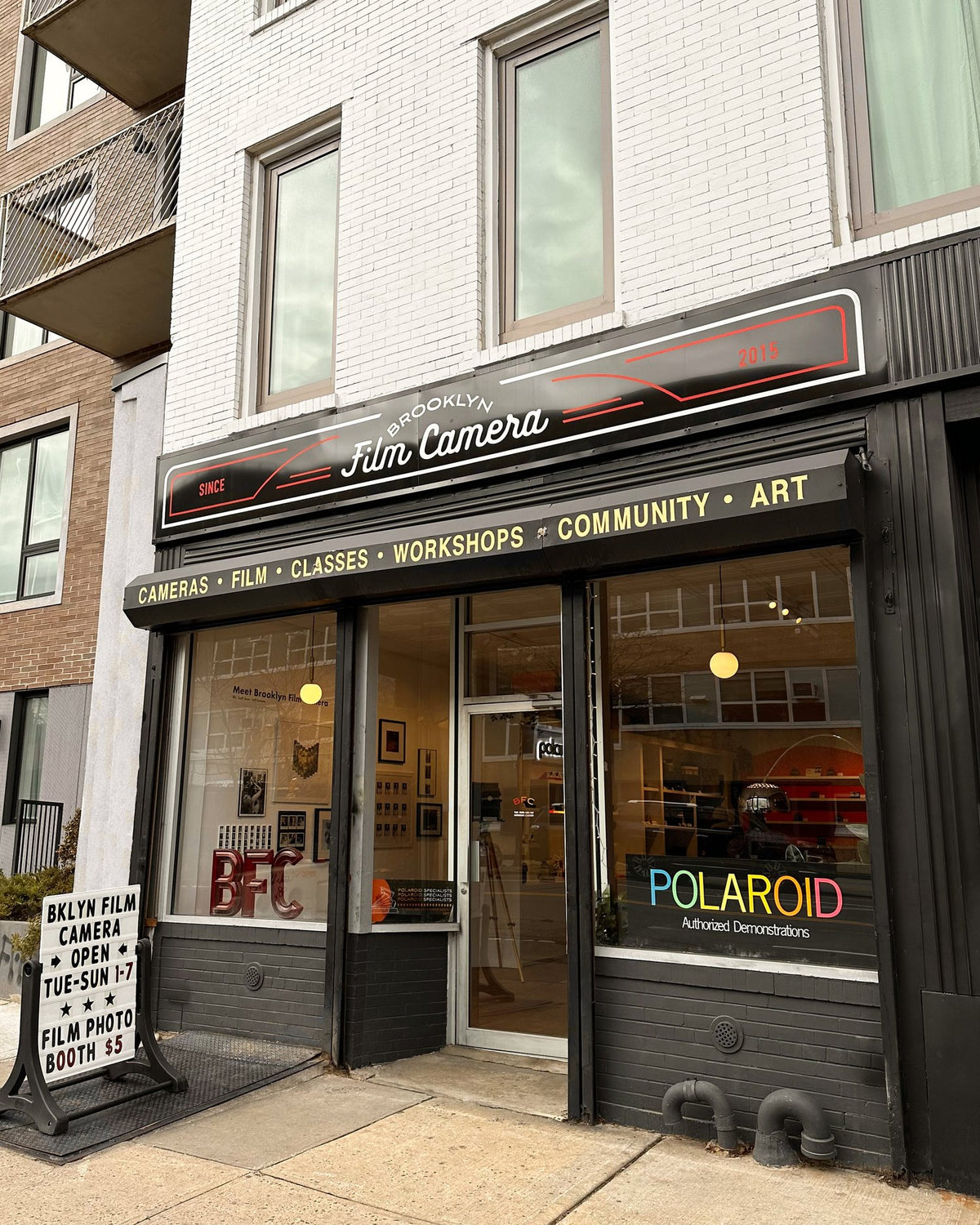
- Brooklyn Film Camera's lab
- Old School Photo Lab
- Richard Photo Lab
- Dwayne's Photo
- Labs we could not price
- How to choose: cheapest, fastest, best scans
- How to pack and ship film safely
- Frequently Asked Questions
- The verdict
How mail order film developing works
The process is the same almost everywhere. You place an order on the lab's site first, choosing your film type, your scan size and any extras. That order generates a number. You write that number on a slip of paper, put it in an envelope with your exposed rolls, and mail it in. The lab checks your film in, emails you to confirm it arrived, processes it, scans it, and sends you a download link. Your negatives come back separately or in the same return envelope, depending on the lab.
A "mailer" is just a prepaid envelope or shipping label. Some labs, including The Darkroom and Old School Photo Lab, send you one free. Old School bakes the return leg into the price too. Others expect you to buy your own postage in one direction and charge you for the return. That difference is worth two or three dollars a roll on a small order, which matters more than it sounds when you are comparing a $10 lab against a $14 lab.
The one thing that trips people up is that turnaround clocks almost never start when you drop the envelope. They start at check-in. If a lab quotes four business days and your film takes four days in transit each way, you are looking at closer to two weeks door to door. Budget for that before you mail anything time-sensitive.
What actually matters when choosing a lab
Scan resolution comes first, because it is where labs quietly differ the most. A "standard" or "base" scan is usually 1,000 to 1,500 pixels on the long edge, a middle tier around 2,000 to 3,000, and a "super" or "ultra" scan somewhere between 6,000 and 6,800 on the long edge. Watch for labs where the top tier buys hand correction rather than pixels: State Film Lab's Pro scan is one of those. As of August 2026, The Darkroom's standard 35mm scan is 1024 x 1536 and its Super Scan is 4492 x 6774. Memphis Film Lab's base scan is 1512 x 1002 and its ultra is 6048 x 4011. A lab quoting $10 a roll at base resolution is not competing with a lab quoting $16 at ultra. Compare tiers, not headline prices.
Second is whether you get your negatives back and what that costs. Most labs return them free. Memphis Film Lab does not: as of August 2026 its return shipping is $6 for a standard order and $8 for a bulk order, on top of the per-roll price. Gelatin Labs offers a "toss negatives" option at checkout. Neither is dishonest, but if you assume negatives are free and they are not, a $10 roll becomes a $16 roll on a one-roll order.
Third is color philosophy. Some labs scan flat and leave the grading to you. Others correct heavily by hand and give you something that looks finished. Richard Photo Lab states outright that trained staff look at your images frame-by-frame and balance to your stated preferences. State Film Lab sells the distinction explicitly: a cheaper Standard scan with minimal correction, a Pro scan with detailed density and color work. Neither is better. If you edit everything anyway, paying for heavy correction is money burned. If you want files you can post the same evening, it is the whole point.
Last is the hidden cost stack: return shipping, push and pull surcharges, TIFF fees, rush fees, and whether E-6 costs extra. Add those up before you decide anything.
Film developing services comparison table
All prices are per developing 35mm film roll and were verified on each lab's own website on 3 August 2026. Develop-only prices are in brackets. Prices change; check before you order.
Mail-in film developing labs compared, 35mm, verified 3 August 2026
| Lab |
Develop + scan, 35mm |
Scan resolution (35mm) |
Turnaround |
Negatives returned |
Formats |
| The Darkroom |
$14 standard / $16 enhanced / $20 super ($11 develop only) |
1024x1536 / 2048x3072 / 4492x6774 |
2–4 days after arrival; 3–5 for E-6, 110 or mixed |
Yes, always, cut and sleeved |
35mm, 120/220/620, 110, 126, 127, APS, single use, sheet film, C-41, B&W, E-6 |
| Memphis Film Lab |
$10 base / $13 standard / $16 ultra / $18 ultra TIFF ($6 develop only) |
1512x1002 / 3024x2005 / 6048x4011 |
~2 weeks; ~4 weeks bulk |
Yes, but +$6 return shipping ($8 bulk) |
35mm, 120, half frame, APS, disposables, C-41, B&W, E-6 |
| State Film Lab |
$14 Standard / $20 Pro ($7 develop only) |
XL upgrade +$4; dimensions not published |
12–15 business days (14–17 on their order page) |
Yes, no charge, 1–2 weeks after completion |
35mm, 120, sheet film, C-41, B&W, E-6 |
| Boutique Film Lab |
$13 Auto / $14 Basic / $19 Premium ($6 process only) |
2000x3000 / 3647x5444 / 4492x6744 |
2 business days C-41 Auto; 4 Basic, Premium and B&W; 7 E-6 and ECN-2 |
Yes, cut and sleeved, held up to 45 days |
35mm, 120, C-41, B&W, E-6, ECN-2 |
| Brooklyn Film Camera |
$18 ($16 members); 4K scan upgrade $12 ($6 members, $4 Serious tier) |
Not published |
4–5 business days |
Yes |
35mm, 120, disposables, C-41, B&W, E-6, push/pull |
| Old School Photo Lab |
$25 ($18 processing + $7 scanning) |
6.5MP 3130x2075 / 30MP 6774x4492 JPG / 30MP TIFF |
Not published |
Yes, free, round-trip postage included |
35mm, 120/220/620, 110, 126, 127/828, APS, 4x5, disposables |
| Richard Photo Lab |
$21.98–$29.98 Web / $23.98–$31.98 Universal / $26.98–$45.98 Project ($10 process only) |
~1025x1450 / ~2050x2790 / ~3350x4550 |
5 business days Noritsu; 9 Frontier |
Yes |
135, 120, 220, C-41, B&W, E-6 |
| Dwayne's Photo |
$11.50 standard / $13.50 hi-res / $15.50 ultra-hi (from $7.50 develop only) |
~2740x1830 / ~6774x4492 |
~12 business days in lab |
Yes, $5 first roll + 50c each additional |
35mm, 120/220, 110, 126, 127, APS, disc, movie film, disposables, C-41, B&W, E-6 |
The Darkroom
Pricing verified 3 August 2026 on The Darkroom’s own pricing page.
The Darkroom is the default recommendation for a reason. As of August 2026, develop-only is $11 a roll, a standard scan package is $14, enhanced is $16 and Super Scan is $20. The inbound mailer is free and postage-paid on request; return shipping is $6.95 per order for USPS First Class, whatever the roll count, or $14.95 Priority. E-6 adds $6. Push or pull is $3. Turnaround is quoted at two to four days after your film arrives for 35mm C-41 and black and white, and three to five days for E-6, 110 or mixed-format orders. That is the fastest published figure in this roundup.
The scan tiers are honestly labeled. A 1024 x 1536 standard scan is a web file and nothing more; the 2048 x 3072 enhanced tier is the one most people should buy; the 4492 x 6774 Super Scan is a genuine 30-megapixel file. Negatives always come back cut and sleeved, or uncut for $3. Their order form has a line for half frame, 110, 126, 127 and APS at $6, panoramic and 220 at $10, and single-use cameras at $3, so the legacy-format coverage is broader than the headline suggests. Kodachrome, disc film and ECN-2 are the notable refusals. Their FAQ warns separately that cartridge formats can run seven to 10 days rather than the headline two to four, so do not send a 126 roll expecting the fast lane. On price, on speed and on transparency they are hard to fault, and if you are cost-sensitive their $11 develop-only is cheaper than ours.
The weakness is character. The Darkroom is a volume operation running high-throughput scanners with a house look, and color negative film comes back looking consistent rather than considered. If you shoot Portra for weddings and care about a specific skin-tone rendering, you will find their corrections generic. They also do not publish a proper hand-scanning option. For a bag of Gold 200 from a holiday, that is irrelevant. For client work, it is the reason people move on to a boutique lab and pay double.
Memphis Film Lab
Pricing verified 3 August 2026 on Memphis Film Lab’s own pricing page.
Memphis is the cheapest mail in film developing we could verify. As of August 2026, 35mm process-only is $6, process plus base scans is $10, standard scans $13, ultra scans $16 and ultra TIFF scans $18. For 120 it is $7 process-only, $10 with base scans, $12 standard and $15 ultra. Black and white and E-6 cost the same as C-41, which is rare. Archival scanning of already-developed film starts at $4 a roll. Their resolutions are published clearly: base 1512 x 1002, standard 3024 x 2005, ultra 6048 x 4011. Files arrive as WeTransfer links and need downloading inside 30 days. They take 35mm, 120, half frame, APS and disposables, but not 110, disc, movie film or ECN-2.
Two things to know before you order. First, negatives are not free. Return shipping is $6 on a standard order and $8 on a bulk order, and you choose at checkout whether you want them back at all. On a single roll that turns a $10 order into $16 and wipes out the price advantage entirely. On a ten-roll order it is noise. Memphis rewards batching.
Second, it is slow. Their own FAQ puts small orders at around two weeks from check-in and bulk orders at around four weeks, measured from when your film is logged rather than when you posted it. That is a real trade. If you shoot a roll a month and want it back quickly, this is the wrong lab. If you shoot in volume, save up ten or twenty rolls and are not in a hurry, nobody in this comparison beats their cost per frame, including us.
State Film Lab
Pricing verified 3 August 2026 on State Film Lab’s own pricing page.
State Film Lab publishes the clearest price list of anyone here. As of August 2026, C-41 develop-only is $7 for 35mm or 120 and B&W is $9, with E-6 at $16. Develop plus a Standard scan is $14 for 35mm C-41 and $12 for 120; the Pro scan, which they describe as including detailed density and color correction, is $20 for 35mm and $17 for 120. B&W Standard is $16 for 35mm and $14 for 120, E-6 Standard is $22 and $20. An XL resolution upgrade on 35mm is $4, TIFFs are $8 for 35mm and $5 for 120, and push or pull up to two stops is free, with a third stop costing $2. Free push processing is unusual and genuinely useful.
Negatives come back at no charge, shipped one to two weeks after your order completes, and scans are delivered as high-resolution JPGs via download link. Note what the Pro tier actually buys: their own description is detailed density and color correction, not a bigger file. Resolution is the separate $4 XL upgrade, and they publish no pixel dimensions for either tier. The two-tier structure is the honest version of the flat-versus-corrected question we described above, and being able to buy the cheap version deliberately is a good thing.
The problem is speed and internal consistency. Their details page quotes 12 to 15 business days for C-41 and B&W, four to six weeks for E-6 and a two-to-three-day rush; their ordering page quotes 14 to 17 business days for standard and four days for rush. Rush is a 50 percent surcharge. Either way, three weeks door to door is a realistic expectation, and we had to read two pages to work out which turnaround figure was current. Great value, clearly documented pricing, but not a lab to send a job to on a deadline.
Boutique Film Lab
Pricing verified 3 August 2026 on Boutique Film Lab’s own pricing page.
Boutique Film Lab in Nashville is the best-structured offering in this comparison. As of August 2026, 35mm process-only is $6 for C-41, $8 for B&W, $12 for E-6 and $15 for ECN-2. Process and scan at the Normal size is $13 for C-41 Auto, $14 for C-41 Basic and $19 for C-41 Premium; 120 comes in at $11, $12 and $16 for the same tiers. Scan-only on developed film is $8 Normal, $12 Large and $16 X-Large for 35mm. TIFFs add $5. Push and pull on C-41 and B&W are free, E-6 is $3 a stop and ECN-2 is $2 a stop.
Their scan sizes are published as real numbers: 35mm Normal is 2000 x 3000, Large is 3647 x 5444 and X-Large is 4492 x 6744, delivered as JPG or TIFF over a Google Drive link. Turnaround is four business days for C-41 Premium and Basic and for B&W, two business days for C-41 Auto, and seven for E-6 and ECN-2. Free push processing plus ECN-2 handling plus published dimensions plus a genuine Auto-versus-Premium correction choice is a lot of lab for the money.
The catch is the negatives. Boutique holds them for up to 45 days after your order completes, which is a batching convenience if you order constantly and a deadline if you do not. Ask for them inside that window. Process-only orders also come back uncut regardless of what you specified, which is not what everyone wants.
Brooklyn Film Camera's lab
Every other lab in this table is a lab. We are a shop with a lab in it, and that changes what happens when a roll comes back wrong. A light leak down one edge, frame spacing that drifts, a soft band across every frame: those are camera faults, not developing faults, and the person who scanned your roll can carry it to our repair bench. We will tell you whether that is a perished foam seal, a slipping advance or a shutter starting to cap, and book the repair. A mail-only lab in another state can only send the roll back and let you work it out. Film, processing and repair under one roof does not exist anywhere else in this comparison.
The service itself is $18 a roll for 35mm or 120, with a 4K scan upgrade at $12, TIFFs at $1 a roll and archival sleeving at $2 an order. C-41, black and white, E-6 slide, push, pull and disposables all run in house, so a mixed order does not get split between two labs. Typical turnaround is four to five business days, which only The Darkroom and Boutique Film Lab beat in this comparison, and your negatives always come back at no extra charge. Order on our film processing page, buy a prepaid label, send the film.
Read the headline prices in the table carefully, because they are not measuring the same thing. Memphis Film Lab's $10 is the lowest number here, and it buys a 1512 by 1002 scan, a 1.5 megapixel file that looks fine on a phone and falls apart in a print. It also does not include your negatives, which are another $6. The Darkroom adds $6.95 to ship your order back. Boutique disposes of negatives after 45 days unless you ask for them. None of that makes those labs bad, and several of them are genuinely excellent, but the cheapest row is rarely the cheapest order.
If you shoot regularly, membership is the real answer on price. From $18 a month, developing drops to $16 a roll, 4K scans to $6, and to $4 on the Serious tier. TIFFs become free and unlimited, sleeving is always free, and you get rolling developing credits, one, three or seven rolls a month by tier, which roll over when you have a slow month. At three rolls a month that lands you below most of this table with your negatives and your next roll of film in the same order.
One thing we do not publish yet is pixel dimensions, which is why our row says not published where most labs give numbers. We are fixing that. Until we do, email us and we will tell you the exact file size you are getting before you order. Better still, come stand at the counter in East Williamsburg, hand us a roll, and ask what went wrong with the last one.
Old School Photo Lab
Pricing verified 3 August 2026 on Old School Photo Lab’s own pricing page.
Old School is the simplest lab here to deal with, and the pricing is the reason. As of August 2026, 35mm film processing is a flat $18 whatever the chemistry: C-41, black and white, E-6 and ECN-2 all cost the same. Nobody else in this table does that. The 120, 220 and 620 line is $19, 110 and APS are $18, 127 and 828 are $19, 4x5 is $11 and 117, 126 and old color stock is $25. Adding scanning to a processing order is $7, so a developed-and-scanned 35mm roll lands at $25 in any process. Scanning already-developed film is $15. Their scan options are HighRes at 6.5 megapixels (3130 x 2075), SuperScan at 30 megapixels (6774 x 4492) as JPG, and ProScan at 30 megapixels as TIFF.
What sets them apart is that round-trip shipping is always included and negatives always come back with a trackable return label at no extra cost. There is no postage line item to reason about and no return-shipping surprise. They also take almost every dead format going: 110, 126, 127, 828, APS, C-22 era stock and old exposed rolls from the back of a drawer.
The weaknesses are cost and opacity. At $25 developed and scanned they have the highest entry price in this table, and they do not publish turnaround times anywhere we could find, which for a mail-in service is a real omission. Their order options run to half-frame scanning, do-not-cut and return-spool; there is no push or pull line, so assume it is a conversation rather than a checkbox. If you have a box of unlabeled family rolls from 1994 and you want them handled carefully by people who have seen everything, they are an excellent choice. If you want to know when your film is coming back, you will have to email and ask.

Richard Photo Lab
Pricing verified 3 August 2026 on Richard Photo Lab’s own pricing page.
Richard Photo Lab is the professional end of this market. As of August 2026, process-only for 135 and 120 is $10 for C-41 or black and white and $17.99 for E-6, with 220 at $13.49 and $21.99. Process and scan is where the price sits: across 135 and 120 in C-41, black and white and E-6, Web Scans run $21.98 to $29.98 a roll depending on format, process and scanner, Universal Scans run $23.98 to $31.98, and Project Scans run $26.98 to $45.98. The cheapest entry point is 120 C-41 on the Noritsu at $21.98; the same job in 135 is $23.98, and 220 pushes past $38 in every tier. Web scans are roughly 1025 x 1450, Universal roughly 2050 x 2790, and Project roughly 3350 x 4550.
The pitch is human color work. They state plainly that trained staff look at images frame-by-frame for consistency, and that custom scans are balanced to your stated preferences rather than a house curve. If you shoot weddings on film and need twelve rolls shot across two days to match, that is what you are paying for, and the difference between this and an automated scan is visible in a gallery.
Two weaknesses. First, resolution per dollar is poor: their Project tier at roughly 3350 x 4550 is about 15 megapixels, which is half of what Dwayne's gives you for $13.50 and smaller than Memphis Film Lab's $16 ultra scan. You are buying labor, not pixels, and you should know that going in. Second, the speed. They publish a rolling turnaround figure, recalculated weekly as the average completion time of the previous week's orders, and as of August 2026 it is five business days for Noritsu scans and nine for Frontier. Five is competitive. Nine is longer than everyone in this table except State Film Lab and Memphis, and Frontier is the scanner a lot of people come here for specifically.
Dwayne's Photo
Pricing verified 3 August 2026 on Dwayne's Photo’s own pricing page.
Dwayne's in Parsons, Kansas has been doing this since 1956 and prices like it. As of August 2026, 35mm color processing starts at $7.50, black and white 35mm starts at $7.50, and 120 or 220 starts at $10. E-6 starts at $12.50 for 35mm and $15 for 120 or 220. Scanning is an add-on: $4 for standard resolution, $6 for high resolution and $8 for ultra-high. That makes a developed and standard-scanned 35mm roll $11.50 and a high-resolution one $13.50. Push or pull is $4 per adjustment. Shipping back is $5 for the first roll and 50 cents for each additional roll.
Their scan specification is published honestly: roughly 2740 x 1830 for a standard scan and roughly 6774 x 4492 for high resolution. That standard tier is meaningfully bigger than what The Darkroom or Memphis call standard, so the $11.50 figure is better value than it first looks, and the $13.50 high-resolution option is a 30-megapixel file for less than most labs charge for a web scan. They also process Super 8 and Regular 8 movie film, disc film, and 110, 126, 127 and APS at $10 a cartridge, and will put your files on a USB stick for $4 if you would rather not download.
The weaknesses are the wait and the website. Their FAQ puts in-lab service at generally 12 business days once your film arrives, which is honest to publish and slow to live with: only State Film Lab and Memphis are slower here. Prices are quoted as "starting at" throughout, so the number you see is rarely the number you pay, and the ordering interface feels like it was built in 2009. None of that affects the negatives you get back, which are fine, but it does affect how confident you feel while you wait.
Labs we could not price
Three well-regarded labs are missing from the table because we could not verify current per-roll prices on their own websites, and we would rather leave a gap than publish a guess. A fourth is missing for a different reason.
Indie Film Lab in Montgomery, Alabama publishes its price list only as an image file and asks you to email for current rates. We could confirm from their FAQ that E-6 carries a $10 per roll fee, pushing is $1 per stop up to three stops, scans are JPEGs at 240 dpi, and non-peak turnaround is five to seven business days for one to 25 rolls and seven to ten for more than 25. Negatives ship uncut and sleeved about a week after your scans, and Pic-Time galleries expire after two weeks.
Gelatin Labs, who run drop boxes across New York and New Jersey alongside mail-in, price everything inside an order configurator rather than a public list. We could verify their scan tiers, now Pro and SuperPro, and their two turnaround options: Fast Pass at one to three business days for C-41, against the flexible option at roughly five to ten business days for C-41, eight to 14 for black and white and up to a month for E-6 and ECN-2. They also offer a "toss negatives" option at checkout instead of paying return shipping.
Nice Film Club's site would not serve pricing to us at all; it is a JavaScript app that returns nothing readable, so we have no verified August 2026 figures for them. Carmencita Film Lab in Spain does publish prices, but in euros and excluding 21 percent VAT, which is why they are not in a dollar table: 5 euros for C-41, 7 for black and white and 10 for E-6 or ECN-2, developing and scanning included, plus 9 euros shipping inside the EU and 15 to 25 outside it. For a US shooter that is a customs question more than a price question.
How to choose: cheapest, fastest, best scans
If you want the cheapest mail in film developing and you can wait, Memphis Film Lab at $10 developed and base-scanned is the lowest verified price here, but only if you batch, because $6 return shipping on a single roll destroys the math. Dwayne's at $11.50 with a genuinely usable standard scan is the better one-roll-at-a-time budget option.
If you want it back fast, The Darkroom's two to four days after arrival is the fastest published figure in this comparison, with Boutique Film Lab's two-day C-41 Auto tier close behind and our own four to five days next. Richard Photo Lab's five days on the Noritsu is competitive; its nine on the Frontier is not. Anything from State Film Lab, Memphis or Dwayne's should be treated as a two-to-three-week round trip.
If you want the most pixels per dollar, the winner is Dwayne's Photo by a wide margin. Their $13.50 high-resolution scan is roughly 6774 x 4492, about 30 megapixels, which works out near 2.3 megapixels per dollar. Boutique's $18 C-41 Auto at X-Large is next at about 1.7, and Memphis Film Lab's $16 ultra and The Darkroom's $20 Super Scan tie at about 1.5. Old School's SuperScan is the same 30-megapixel file for $25, so 1.2. Boutique's $16 X-Large scan-only tier is the best deal if you develop at home. None of this measures scan quality or color work, only file size, which is exactly the point: buy pixels and correction separately and know which one you are paying for.
If you are shooting professionally and consistency between rolls is the job, Richard Photo Lab is the answer even though the files are smaller and the Frontier queue is long, with Boutique's Premium tier as the cheaper alternative. And if you shoot enough that a monthly plan makes sense, run the membership numbers before you compare per-roll prices. At three or more rolls a month, subscription pricing changes the ranking completely.
How to pack and ship film safely
Use a padded mailer, not a flat-rate envelope. Memphis Film Lab specifically warns that flat-rate envelopes tear in transit, and we have received film in shredded paper envelopes more than once. Put the rolls in a zip bag inside the mailer so a rain-soaked envelope does not mean a ruined order. State Film Lab's own shipping instructions say to package film in an airtight plastic bag and then secure that inside a box, which is the right level of paranoia.
Always pay for tracking. It costs a couple of dollars and it is the only evidence you will have if a package goes missing, and a lost mailer of exposed film is not something an insurer can replace.
Write your order number on a slip and put it inside, along with anything non-standard: the film stock, the format, and above all the exposure index if you pushed or pulled. "HP5 shot at EI 1600, push 2" is unambiguous. "Push it" is not. No lab can tell from looking at a cassette what you rated it at, and a pushed roll processed normally comes back thin and unfixable.
If you are hand-carrying film to a lab or traveling with it, keep it out of the CT scanners now standard at airport security. Kodak Alaris strongly advises against putting any unexposed or unprocessed film through a CT scanner and tells travelers not to check film, since checked bags are CT-scanned too. Pack film in a clear bag, take it out of your carry-on, and request a hand inspection. High-ISO stock is the most vulnerable, but the current advice is to keep everything out of the beam.
Frequently Asked Questions
How much does it cost to develop film by mail?
As of August 2026, expect $10 to $25 per 35mm roll developed and scanned. The cheapest verified option here is Memphis Film Lab at $10 with base scans; the most expensive entry price is Old School Photo Lab at $25. Develop-only, without scans, runs $6 to $18. Return shipping is extra at some labs.
Is it safe to mail film?
Yes. Postal sorting equipment does not use the CT scanners that damage film, and millions of rolls are mailed to labs every year without incident. Use a padded mailer, seal the rolls in a zip bag, and pay for tracking. The genuine risk is a lost package, not radiation, so tracking is the real protection.
Do labs send your negatives back?
Most do, at no charge. The Darkroom, Old School Photo Lab and State Film Lab all return negatives as standard, and Old School includes round-trip postage. Memphis Film Lab charges $6 for standard return shipping and $8 for bulk, and Dwayne's charges $5 plus 50 cents a roll. Gelatin Labs lets you discard them. Always check at checkout.
How long does mail-in film developing take?
Lab turnaround ranges from two business days to four weeks, and the clock usually starts at check-in rather than when you post. The Darkroom quotes two to four days, Boutique Film Lab two on C-41 Auto, our lab four to five business days, Richard Photo Lab five on the Noritsu, Dwayne's about 12 and State Film Lab 12 to 15. Add four to eight days for transit both ways.
Where should I send film to be developed for the best scans?
It depends on what "best" means. For the largest file per dollar, Dwayne's Photo wins outright: about 6774 x 4492 for $13.50 developed and scanned. For the most careful frame-by-frame color work, Richard Photo Lab or Boutique Film Lab's Premium tier. Resolution and color quality are separate purchases.
Can labs push or pull film by mail?
Yes, and it is often free. State Film Lab includes push and pull up to two stops at no charge, and Boutique Film Lab includes it free for C-41 and black and white. The Darkroom charges $3 and Dwayne's charges $4. We handle push and pull in our Brooklyn lab. Write your exposure index on the order slip. Pushing is most common on CineStill 800T, which we cover in full separately.
The verdict
All competitor pricing checked 3 August 2026 against each lab's own website. Lab pricing moves; check before you ship.
Best overall, as of August 2026, is The Darkroom: $14 developed and scanned, a free inbound mailer, $6.95 return shipping for the whole order, negatives always returned, and a two-to-four-day turnaround nobody else beats. Best budget is Memphis Film Lab at $10 a roll. Best pixels per dollar is Dwayne's Photo at $13.50 for a 30-megapixel scan, if you can wait 12 business days for it. Best for professionals is Richard Photo Lab for hand-corrected consistency, with Boutique Film Lab as the value alternative if you want published scan dimensions and free push processing.
Best for anyone who wants a lab they can actually talk to is us. Four to five business days on C-41, black and white, E-6, push, pull and disposables, run by the people who sold you the film and can fix the camera that shot it. Nobody else in this table can look at a light leak and book the repair. That is what $18 a roll buys, or $16 with a membership, and we take mail-in from anywhere in the world.
Start at our film processing page, stock up from our full film collection (Kodak Gold 200 at $10, Portra 400 at $18.50, CineStill 800T at $18), and email us before you mail anything unusual.
Share Your Shots
Tag your mail-in lab photos with #BFCfilmclub


Film Developing by Mail: 8 Labs Compared
Film developing by mail is how most people get their film processed now. The corner minilab is gone in most of the country, and even in a city like ours a lot of shooters would rather drop a padded envelope in a mailbox than carry a bag of exposed rolls across town. We run a developing lab in East Williamsburg and we take mail-in orders from all over the world, so we watch this market closely. We also know that the honest answer to "which lab should I use" is not always us. This post compares eight mail-in labs on the things that actually decide the question: price per roll, scan resolution, turnaround, whether you get your negatives back, and what the hidden charges are. Every price here was checked on the lab's own website in August 2026.
In This Review
How mail order film developing works
The process is the same almost everywhere. You place an order on the lab's site first, choosing your film type, your scan size and any extras. That order generates a number. You write that number on a slip of paper, put it in an envelope with your exposed rolls, and mail it in. The lab checks your film in, emails you to confirm it arrived, processes it, scans it, and sends you a download link. Your negatives come back separately or in the same return envelope, depending on the lab.
A "mailer" is just a prepaid envelope or shipping label. Some labs, including The Darkroom and Old School Photo Lab, send you one free. Old School bakes the return leg into the price too. Others expect you to buy your own postage in one direction and charge you for the return. That difference is worth two or three dollars a roll on a small order, which matters more than it sounds when you are comparing a $10 lab against a $14 lab.
The one thing that trips people up is that turnaround clocks almost never start when you drop the envelope. They start at check-in. If a lab quotes four business days and your film takes four days in transit each way, you are looking at closer to two weeks door to door. Budget for that before you mail anything time-sensitive.
What actually matters when choosing a lab
Scan resolution comes first, because it is where labs quietly differ the most. A "standard" or "base" scan is usually 1,000 to 1,500 pixels on the long edge, a middle tier around 2,000 to 3,000, and a "super" or "ultra" scan somewhere between 6,000 and 6,800 on the long edge. Watch for labs where the top tier buys hand correction rather than pixels: State Film Lab's Pro scan is one of those. As of August 2026, The Darkroom's standard 35mm scan is 1024 x 1536 and its Super Scan is 4492 x 6774. Memphis Film Lab's base scan is 1512 x 1002 and its ultra is 6048 x 4011. A lab quoting $10 a roll at base resolution is not competing with a lab quoting $16 at ultra. Compare tiers, not headline prices.
Second is whether you get your negatives back and what that costs. Most labs return them free. Memphis Film Lab does not: as of August 2026 its return shipping is $6 for a standard order and $8 for a bulk order, on top of the per-roll price. Gelatin Labs offers a "toss negatives" option at checkout. Neither is dishonest, but if you assume negatives are free and they are not, a $10 roll becomes a $16 roll on a one-roll order.
Third is color philosophy. Some labs scan flat and leave the grading to you. Others correct heavily by hand and give you something that looks finished. Richard Photo Lab states outright that trained staff look at your images frame-by-frame and balance to your stated preferences. State Film Lab sells the distinction explicitly: a cheaper Standard scan with minimal correction, a Pro scan with detailed density and color work. Neither is better. If you edit everything anyway, paying for heavy correction is money burned. If you want files you can post the same evening, it is the whole point.
Last is the hidden cost stack: return shipping, push and pull surcharges, TIFF fees, rush fees, and whether E-6 costs extra. Add those up before you decide anything.
Film developing services comparison table
All prices are per developing 35mm film roll and were verified on each lab's own website on 3 August 2026. Develop-only prices are in brackets. Prices change; check before you order.
The Darkroom
Pricing verified 3 August 2026 on The Darkroom’s own pricing page.
The Darkroom is the default recommendation for a reason. As of August 2026, develop-only is $11 a roll, a standard scan package is $14, enhanced is $16 and Super Scan is $20. The inbound mailer is free and postage-paid on request; return shipping is $6.95 per order for USPS First Class, whatever the roll count, or $14.95 Priority. E-6 adds $6. Push or pull is $3. Turnaround is quoted at two to four days after your film arrives for 35mm C-41 and black and white, and three to five days for E-6, 110 or mixed-format orders. That is the fastest published figure in this roundup.
The scan tiers are honestly labeled. A 1024 x 1536 standard scan is a web file and nothing more; the 2048 x 3072 enhanced tier is the one most people should buy; the 4492 x 6774 Super Scan is a genuine 30-megapixel file. Negatives always come back cut and sleeved, or uncut for $3. Their order form has a line for half frame, 110, 126, 127 and APS at $6, panoramic and 220 at $10, and single-use cameras at $3, so the legacy-format coverage is broader than the headline suggests. Kodachrome, disc film and ECN-2 are the notable refusals. Their FAQ warns separately that cartridge formats can run seven to 10 days rather than the headline two to four, so do not send a 126 roll expecting the fast lane. On price, on speed and on transparency they are hard to fault, and if you are cost-sensitive their $11 develop-only is cheaper than ours.
The weakness is character. The Darkroom is a volume operation running high-throughput scanners with a house look, and color negative film comes back looking consistent rather than considered. If you shoot Portra for weddings and care about a specific skin-tone rendering, you will find their corrections generic. They also do not publish a proper hand-scanning option. For a bag of Gold 200 from a holiday, that is irrelevant. For client work, it is the reason people move on to a boutique lab and pay double.
Memphis Film Lab
Pricing verified 3 August 2026 on Memphis Film Lab’s own pricing page.
Memphis is the cheapest mail in film developing we could verify. As of August 2026, 35mm process-only is $6, process plus base scans is $10, standard scans $13, ultra scans $16 and ultra TIFF scans $18. For 120 it is $7 process-only, $10 with base scans, $12 standard and $15 ultra. Black and white and E-6 cost the same as C-41, which is rare. Archival scanning of already-developed film starts at $4 a roll. Their resolutions are published clearly: base 1512 x 1002, standard 3024 x 2005, ultra 6048 x 4011. Files arrive as WeTransfer links and need downloading inside 30 days. They take 35mm, 120, half frame, APS and disposables, but not 110, disc, movie film or ECN-2.
Two things to know before you order. First, negatives are not free. Return shipping is $6 on a standard order and $8 on a bulk order, and you choose at checkout whether you want them back at all. On a single roll that turns a $10 order into $16 and wipes out the price advantage entirely. On a ten-roll order it is noise. Memphis rewards batching.
Second, it is slow. Their own FAQ puts small orders at around two weeks from check-in and bulk orders at around four weeks, measured from when your film is logged rather than when you posted it. That is a real trade. If you shoot a roll a month and want it back quickly, this is the wrong lab. If you shoot in volume, save up ten or twenty rolls and are not in a hurry, nobody in this comparison beats their cost per frame, including us.
State Film Lab
Pricing verified 3 August 2026 on State Film Lab’s own pricing page.
State Film Lab publishes the clearest price list of anyone here. As of August 2026, C-41 develop-only is $7 for 35mm or 120 and B&W is $9, with E-6 at $16. Develop plus a Standard scan is $14 for 35mm C-41 and $12 for 120; the Pro scan, which they describe as including detailed density and color correction, is $20 for 35mm and $17 for 120. B&W Standard is $16 for 35mm and $14 for 120, E-6 Standard is $22 and $20. An XL resolution upgrade on 35mm is $4, TIFFs are $8 for 35mm and $5 for 120, and push or pull up to two stops is free, with a third stop costing $2. Free push processing is unusual and genuinely useful.
Negatives come back at no charge, shipped one to two weeks after your order completes, and scans are delivered as high-resolution JPGs via download link. Note what the Pro tier actually buys: their own description is detailed density and color correction, not a bigger file. Resolution is the separate $4 XL upgrade, and they publish no pixel dimensions for either tier. The two-tier structure is the honest version of the flat-versus-corrected question we described above, and being able to buy the cheap version deliberately is a good thing.
The problem is speed and internal consistency. Their details page quotes 12 to 15 business days for C-41 and B&W, four to six weeks for E-6 and a two-to-three-day rush; their ordering page quotes 14 to 17 business days for standard and four days for rush. Rush is a 50 percent surcharge. Either way, three weeks door to door is a realistic expectation, and we had to read two pages to work out which turnaround figure was current. Great value, clearly documented pricing, but not a lab to send a job to on a deadline.
Boutique Film Lab
Pricing verified 3 August 2026 on Boutique Film Lab’s own pricing page.
Boutique Film Lab in Nashville is the best-structured offering in this comparison. As of August 2026, 35mm process-only is $6 for C-41, $8 for B&W, $12 for E-6 and $15 for ECN-2. Process and scan at the Normal size is $13 for C-41 Auto, $14 for C-41 Basic and $19 for C-41 Premium; 120 comes in at $11, $12 and $16 for the same tiers. Scan-only on developed film is $8 Normal, $12 Large and $16 X-Large for 35mm. TIFFs add $5. Push and pull on C-41 and B&W are free, E-6 is $3 a stop and ECN-2 is $2 a stop.
Their scan sizes are published as real numbers: 35mm Normal is 2000 x 3000, Large is 3647 x 5444 and X-Large is 4492 x 6744, delivered as JPG or TIFF over a Google Drive link. Turnaround is four business days for C-41 Premium and Basic and for B&W, two business days for C-41 Auto, and seven for E-6 and ECN-2. Free push processing plus ECN-2 handling plus published dimensions plus a genuine Auto-versus-Premium correction choice is a lot of lab for the money.
The catch is the negatives. Boutique holds them for up to 45 days after your order completes, which is a batching convenience if you order constantly and a deadline if you do not. Ask for them inside that window. Process-only orders also come back uncut regardless of what you specified, which is not what everyone wants.
Brooklyn Film Camera's lab
Every other lab in this table is a lab. We are a shop with a lab in it, and that changes what happens when a roll comes back wrong. A light leak down one edge, frame spacing that drifts, a soft band across every frame: those are camera faults, not developing faults, and the person who scanned your roll can carry it to our repair bench. We will tell you whether that is a perished foam seal, a slipping advance or a shutter starting to cap, and book the repair. A mail-only lab in another state can only send the roll back and let you work it out. Film, processing and repair under one roof does not exist anywhere else in this comparison.
The service itself is $18 a roll for 35mm or 120, with a 4K scan upgrade at $12, TIFFs at $1 a roll and archival sleeving at $2 an order. C-41, black and white, E-6 slide, push, pull and disposables all run in house, so a mixed order does not get split between two labs. Typical turnaround is four to five business days, which only The Darkroom and Boutique Film Lab beat in this comparison, and your negatives always come back at no extra charge. Order on our film processing page, buy a prepaid label, send the film.
Read the headline prices in the table carefully, because they are not measuring the same thing. Memphis Film Lab's $10 is the lowest number here, and it buys a 1512 by 1002 scan, a 1.5 megapixel file that looks fine on a phone and falls apart in a print. It also does not include your negatives, which are another $6. The Darkroom adds $6.95 to ship your order back. Boutique disposes of negatives after 45 days unless you ask for them. None of that makes those labs bad, and several of them are genuinely excellent, but the cheapest row is rarely the cheapest order.
If you shoot regularly, membership is the real answer on price. From $18 a month, developing drops to $16 a roll, 4K scans to $6, and to $4 on the Serious tier. TIFFs become free and unlimited, sleeving is always free, and you get rolling developing credits, one, three or seven rolls a month by tier, which roll over when you have a slow month. At three rolls a month that lands you below most of this table with your negatives and your next roll of film in the same order.
One thing we do not publish yet is pixel dimensions, which is why our row says not published where most labs give numbers. We are fixing that. Until we do, email us and we will tell you the exact file size you are getting before you order. Better still, come stand at the counter in East Williamsburg, hand us a roll, and ask what went wrong with the last one.
Old School Photo Lab
Pricing verified 3 August 2026 on Old School Photo Lab’s own pricing page.
Old School is the simplest lab here to deal with, and the pricing is the reason. As of August 2026, 35mm film processing is a flat $18 whatever the chemistry: C-41, black and white, E-6 and ECN-2 all cost the same. Nobody else in this table does that. The 120, 220 and 620 line is $19, 110 and APS are $18, 127 and 828 are $19, 4x5 is $11 and 117, 126 and old color stock is $25. Adding scanning to a processing order is $7, so a developed-and-scanned 35mm roll lands at $25 in any process. Scanning already-developed film is $15. Their scan options are HighRes at 6.5 megapixels (3130 x 2075), SuperScan at 30 megapixels (6774 x 4492) as JPG, and ProScan at 30 megapixels as TIFF.
What sets them apart is that round-trip shipping is always included and negatives always come back with a trackable return label at no extra cost. There is no postage line item to reason about and no return-shipping surprise. They also take almost every dead format going: 110, 126, 127, 828, APS, C-22 era stock and old exposed rolls from the back of a drawer.
The weaknesses are cost and opacity. At $25 developed and scanned they have the highest entry price in this table, and they do not publish turnaround times anywhere we could find, which for a mail-in service is a real omission. Their order options run to half-frame scanning, do-not-cut and return-spool; there is no push or pull line, so assume it is a conversation rather than a checkbox. If you have a box of unlabeled family rolls from 1994 and you want them handled carefully by people who have seen everything, they are an excellent choice. If you want to know when your film is coming back, you will have to email and ask.
Richard Photo Lab
Pricing verified 3 August 2026 on Richard Photo Lab’s own pricing page.
Richard Photo Lab is the professional end of this market. As of August 2026, process-only for 135 and 120 is $10 for C-41 or black and white and $17.99 for E-6, with 220 at $13.49 and $21.99. Process and scan is where the price sits: across 135 and 120 in C-41, black and white and E-6, Web Scans run $21.98 to $29.98 a roll depending on format, process and scanner, Universal Scans run $23.98 to $31.98, and Project Scans run $26.98 to $45.98. The cheapest entry point is 120 C-41 on the Noritsu at $21.98; the same job in 135 is $23.98, and 220 pushes past $38 in every tier. Web scans are roughly 1025 x 1450, Universal roughly 2050 x 2790, and Project roughly 3350 x 4550.
The pitch is human color work. They state plainly that trained staff look at images frame-by-frame for consistency, and that custom scans are balanced to your stated preferences rather than a house curve. If you shoot weddings on film and need twelve rolls shot across two days to match, that is what you are paying for, and the difference between this and an automated scan is visible in a gallery.
Two weaknesses. First, resolution per dollar is poor: their Project tier at roughly 3350 x 4550 is about 15 megapixels, which is half of what Dwayne's gives you for $13.50 and smaller than Memphis Film Lab's $16 ultra scan. You are buying labor, not pixels, and you should know that going in. Second, the speed. They publish a rolling turnaround figure, recalculated weekly as the average completion time of the previous week's orders, and as of August 2026 it is five business days for Noritsu scans and nine for Frontier. Five is competitive. Nine is longer than everyone in this table except State Film Lab and Memphis, and Frontier is the scanner a lot of people come here for specifically.
Dwayne's Photo
Pricing verified 3 August 2026 on Dwayne's Photo’s own pricing page.
Dwayne's in Parsons, Kansas has been doing this since 1956 and prices like it. As of August 2026, 35mm color processing starts at $7.50, black and white 35mm starts at $7.50, and 120 or 220 starts at $10. E-6 starts at $12.50 for 35mm and $15 for 120 or 220. Scanning is an add-on: $4 for standard resolution, $6 for high resolution and $8 for ultra-high. That makes a developed and standard-scanned 35mm roll $11.50 and a high-resolution one $13.50. Push or pull is $4 per adjustment. Shipping back is $5 for the first roll and 50 cents for each additional roll.
Their scan specification is published honestly: roughly 2740 x 1830 for a standard scan and roughly 6774 x 4492 for high resolution. That standard tier is meaningfully bigger than what The Darkroom or Memphis call standard, so the $11.50 figure is better value than it first looks, and the $13.50 high-resolution option is a 30-megapixel file for less than most labs charge for a web scan. They also process Super 8 and Regular 8 movie film, disc film, and 110, 126, 127 and APS at $10 a cartridge, and will put your files on a USB stick for $4 if you would rather not download.
The weaknesses are the wait and the website. Their FAQ puts in-lab service at generally 12 business days once your film arrives, which is honest to publish and slow to live with: only State Film Lab and Memphis are slower here. Prices are quoted as "starting at" throughout, so the number you see is rarely the number you pay, and the ordering interface feels like it was built in 2009. None of that affects the negatives you get back, which are fine, but it does affect how confident you feel while you wait.
Labs we could not price
Three well-regarded labs are missing from the table because we could not verify current per-roll prices on their own websites, and we would rather leave a gap than publish a guess. A fourth is missing for a different reason.
Indie Film Lab in Montgomery, Alabama publishes its price list only as an image file and asks you to email for current rates. We could confirm from their FAQ that E-6 carries a $10 per roll fee, pushing is $1 per stop up to three stops, scans are JPEGs at 240 dpi, and non-peak turnaround is five to seven business days for one to 25 rolls and seven to ten for more than 25. Negatives ship uncut and sleeved about a week after your scans, and Pic-Time galleries expire after two weeks.
Gelatin Labs, who run drop boxes across New York and New Jersey alongside mail-in, price everything inside an order configurator rather than a public list. We could verify their scan tiers, now Pro and SuperPro, and their two turnaround options: Fast Pass at one to three business days for C-41, against the flexible option at roughly five to ten business days for C-41, eight to 14 for black and white and up to a month for E-6 and ECN-2. They also offer a "toss negatives" option at checkout instead of paying return shipping.
Nice Film Club's site would not serve pricing to us at all; it is a JavaScript app that returns nothing readable, so we have no verified August 2026 figures for them. Carmencita Film Lab in Spain does publish prices, but in euros and excluding 21 percent VAT, which is why they are not in a dollar table: 5 euros for C-41, 7 for black and white and 10 for E-6 or ECN-2, developing and scanning included, plus 9 euros shipping inside the EU and 15 to 25 outside it. For a US shooter that is a customs question more than a price question.
How to choose: cheapest, fastest, best scans
If you want the cheapest mail in film developing and you can wait, Memphis Film Lab at $10 developed and base-scanned is the lowest verified price here, but only if you batch, because $6 return shipping on a single roll destroys the math. Dwayne's at $11.50 with a genuinely usable standard scan is the better one-roll-at-a-time budget option.
If you want it back fast, The Darkroom's two to four days after arrival is the fastest published figure in this comparison, with Boutique Film Lab's two-day C-41 Auto tier close behind and our own four to five days next. Richard Photo Lab's five days on the Noritsu is competitive; its nine on the Frontier is not. Anything from State Film Lab, Memphis or Dwayne's should be treated as a two-to-three-week round trip.
If you want the most pixels per dollar, the winner is Dwayne's Photo by a wide margin. Their $13.50 high-resolution scan is roughly 6774 x 4492, about 30 megapixels, which works out near 2.3 megapixels per dollar. Boutique's $18 C-41 Auto at X-Large is next at about 1.7, and Memphis Film Lab's $16 ultra and The Darkroom's $20 Super Scan tie at about 1.5. Old School's SuperScan is the same 30-megapixel file for $25, so 1.2. Boutique's $16 X-Large scan-only tier is the best deal if you develop at home. None of this measures scan quality or color work, only file size, which is exactly the point: buy pixels and correction separately and know which one you are paying for.
If you are shooting professionally and consistency between rolls is the job, Richard Photo Lab is the answer even though the files are smaller and the Frontier queue is long, with Boutique's Premium tier as the cheaper alternative. And if you shoot enough that a monthly plan makes sense, run the membership numbers before you compare per-roll prices. At three or more rolls a month, subscription pricing changes the ranking completely.
How to pack and ship film safely
Use a padded mailer, not a flat-rate envelope. Memphis Film Lab specifically warns that flat-rate envelopes tear in transit, and we have received film in shredded paper envelopes more than once. Put the rolls in a zip bag inside the mailer so a rain-soaked envelope does not mean a ruined order. State Film Lab's own shipping instructions say to package film in an airtight plastic bag and then secure that inside a box, which is the right level of paranoia.
Always pay for tracking. It costs a couple of dollars and it is the only evidence you will have if a package goes missing, and a lost mailer of exposed film is not something an insurer can replace.
Write your order number on a slip and put it inside, along with anything non-standard: the film stock, the format, and above all the exposure index if you pushed or pulled. "HP5 shot at EI 1600, push 2" is unambiguous. "Push it" is not. No lab can tell from looking at a cassette what you rated it at, and a pushed roll processed normally comes back thin and unfixable.
If you are hand-carrying film to a lab or traveling with it, keep it out of the CT scanners now standard at airport security. Kodak Alaris strongly advises against putting any unexposed or unprocessed film through a CT scanner and tells travelers not to check film, since checked bags are CT-scanned too. Pack film in a clear bag, take it out of your carry-on, and request a hand inspection. High-ISO stock is the most vulnerable, but the current advice is to keep everything out of the beam.
Frequently Asked Questions
How much does it cost to develop film by mail?
As of August 2026, expect $10 to $25 per 35mm roll developed and scanned. The cheapest verified option here is Memphis Film Lab at $10 with base scans; the most expensive entry price is Old School Photo Lab at $25. Develop-only, without scans, runs $6 to $18. Return shipping is extra at some labs.
Is it safe to mail film?
Yes. Postal sorting equipment does not use the CT scanners that damage film, and millions of rolls are mailed to labs every year without incident. Use a padded mailer, seal the rolls in a zip bag, and pay for tracking. The genuine risk is a lost package, not radiation, so tracking is the real protection.
Do labs send your negatives back?
Most do, at no charge. The Darkroom, Old School Photo Lab and State Film Lab all return negatives as standard, and Old School includes round-trip postage. Memphis Film Lab charges $6 for standard return shipping and $8 for bulk, and Dwayne's charges $5 plus 50 cents a roll. Gelatin Labs lets you discard them. Always check at checkout.
How long does mail-in film developing take?
Lab turnaround ranges from two business days to four weeks, and the clock usually starts at check-in rather than when you post. The Darkroom quotes two to four days, Boutique Film Lab two on C-41 Auto, our lab four to five business days, Richard Photo Lab five on the Noritsu, Dwayne's about 12 and State Film Lab 12 to 15. Add four to eight days for transit both ways.
Where should I send film to be developed for the best scans?
It depends on what "best" means. For the largest file per dollar, Dwayne's Photo wins outright: about 6774 x 4492 for $13.50 developed and scanned. For the most careful frame-by-frame color work, Richard Photo Lab or Boutique Film Lab's Premium tier. Resolution and color quality are separate purchases.
Can labs push or pull film by mail?
Yes, and it is often free. State Film Lab includes push and pull up to two stops at no charge, and Boutique Film Lab includes it free for C-41 and black and white. The Darkroom charges $3 and Dwayne's charges $4. We handle push and pull in our Brooklyn lab. Write your exposure index on the order slip. Pushing is most common on CineStill 800T, which we cover in full separately.
The verdict
All competitor pricing checked 3 August 2026 against each lab's own website. Lab pricing moves; check before you ship.
Best overall, as of August 2026, is The Darkroom: $14 developed and scanned, a free inbound mailer, $6.95 return shipping for the whole order, negatives always returned, and a two-to-four-day turnaround nobody else beats. Best budget is Memphis Film Lab at $10 a roll. Best pixels per dollar is Dwayne's Photo at $13.50 for a 30-megapixel scan, if you can wait 12 business days for it. Best for professionals is Richard Photo Lab for hand-corrected consistency, with Boutique Film Lab as the value alternative if you want published scan dimensions and free push processing.
Best for anyone who wants a lab they can actually talk to is us. Four to five business days on C-41, black and white, E-6, push, pull and disposables, run by the people who sold you the film and can fix the camera that shot it. Nobody else in this table can look at a light leak and book the repair. That is what $18 a roll buys, or $16 with a membership, and we take mail-in from anywhere in the world.
Start at our film processing page, stock up from our full film collection (Kodak Gold 200 at $10, Portra 400 at $18.50, CineStill 800T at $18), and email us before you mail anything unusual.
Share Your Shots
Tag your mail-in lab photos with #BFCfilmclub
Griffin Malone
Griffin does construction, project management, some photography, and bartending. When not working you may catch them playing pool, pinball, or biking around Brooklyn.
Related Articles
What Film Camera Repair Costs in 2026: A Complete CLA & Pricing Guide
What a CLA costs, what a repair costs, and when neither one is worth it.
CineStill 400D Review: The Daylight Cinema Film
Daylight balanced, ISO 400, and the halation glow without the tungsten cast film stock.
Canon WP-1 Review: A Waterproof Point-and-Shoot That Actually Delivers
A wacky-looking, rubber-armored 35mm camera that punches way above its price tag.